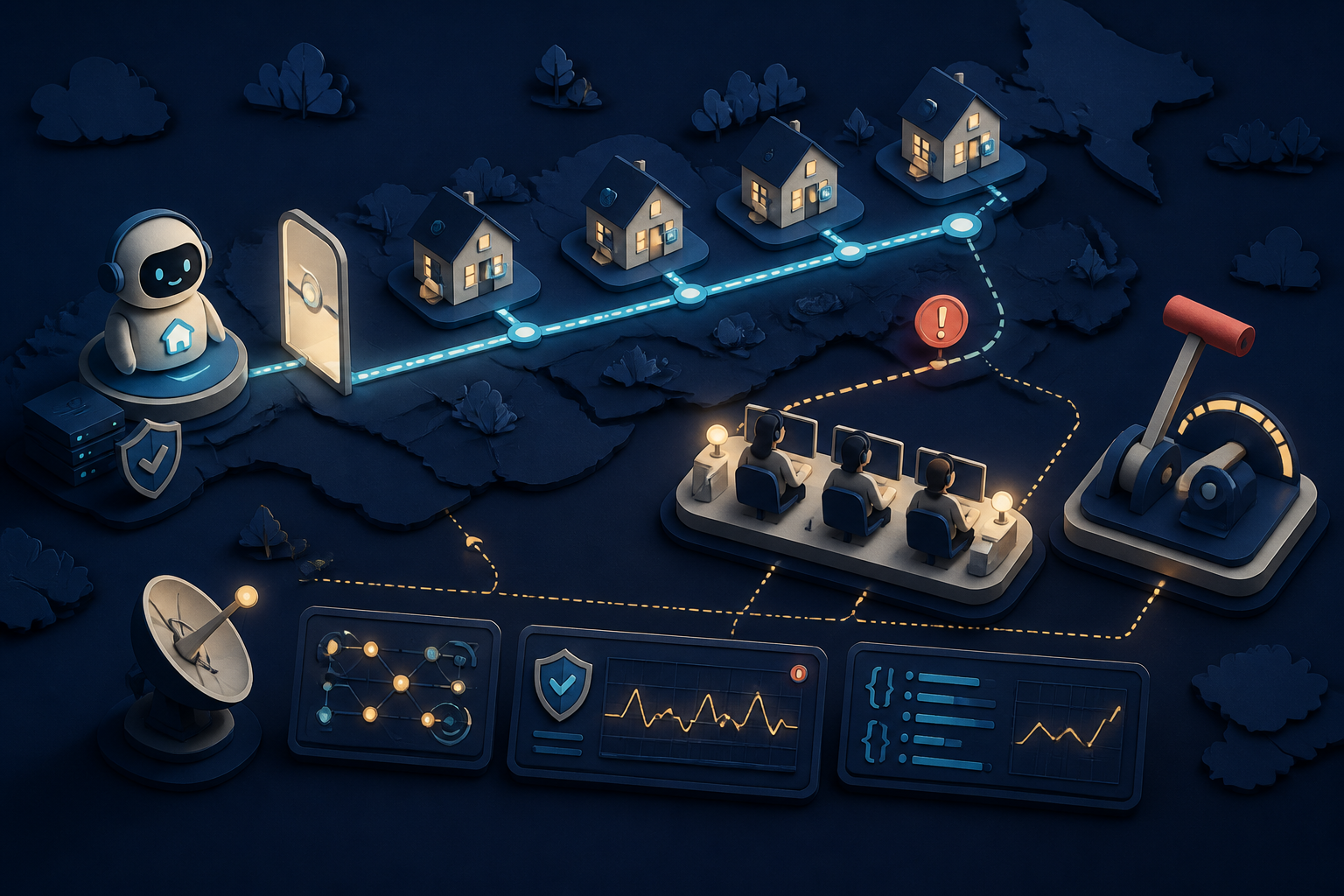
A useful support bot is built through a pipeline, not downloaded fully formed.
Your mission: prepare HomeSync v0.1 for smart-home support. It must recognize a dangerous heater message, answer in a helpful support voice, and work with HomeSync’s own API codes. Right now it is only an untrained set of adjustable weights—not a support agent.
You will make the calls that shape it. Keep an eye on the Model Card: a number going up is not enough; the four signals represent different kinds of readiness.
Pipeline map
The six stations
The ordered training pipeline assigns a different responsibility to every stage.
Training is a relay, not one button:
Collect examples relevant to the job.
Clean and label them so the target signal is trustworthy.
Pretrain on huge text collections to learn language patterns and broad knowledge.
Fine-tune and align the base model to follow helpful, safe, task-shaped behavior.
Evaluate with held-out tests—including the real workflow.
Deploy carefully, monitor failures, and feed lessons into the next data cycle.
No station can honestly do another station’s job. Evaluation can discover a bad label; it cannot make a raw base model behave like a polished support agent.
Conveyor: —
Level 1 / collection
Level 1: Choose data with the job in mind
Collection selects the evidence the model will later learn from.
A vendor offers two data bundles. Budget allows one first pass.
A — General web chat archive. Millions of casual conversations, broad language coverage, almost no smart-home troubleshooting.
B — HomeSync support archive. Fewer anonymized tickets, manuals, error-code articles, and safely handled escalation transcripts.
Choose what starts the collection stage. Quantity helps a model learn broad patterns; relevance supplies evidence for this job. The later pretraining stage can be broad, but a support product also needs task-relevant examples and policies.
Consequence / coverage gap
Coverage gap detected
Broad language data alone does not supply evidence for a specific support workflow.
General web chat is viable for language breadth but leaves a coverage gap in HomeSync cases. The Model Card records lower Task Readiness: a system cannot learn its proprietary error-code and escalation workflow from examples it never sees. Return to collection and choose the first-pass bundle for the actual job.
Level 2 / data review
Level 2: A row that can bend the boundary
Cleaning and labeling define the target the model is optimized toward.
You inspect this actual training row:
text: “My heater is sparking and smoking!” current label: General Inquiry
The classifier already assigns a high probability to Emergency/Safety. The row’s label tells training to push the model the other way. What do you send into training?
A — Keep General Inquiry. It is only one row; the dataset is large.
B — Correct it to Emergency/Safety and log the label rule.
The correct label is not a cosmetic tag. It is the ground truth used to calculate loss.
Decision gate
Send the row into training
The label is the ground truth used to calculate loss.
Choose the label that will become the optimization target for this row.
Consequence / unsafe update
Weight distortion alert
A high-confidence wrong label can create a disproportionately strong update.
The Safety Signal drops sharply and the event log reads: “unsafe routing pattern learned.” Keeping the label makes the model treat a confident Emergency/Safety prediction as wrong. That severe contradiction produces a loss spike and a large gradient that pushes weights toward General Inquiry. Return to the row and repair the target before training continues.
Mechanism lab
Why one wrong label can matter
A confident mislabeled example creates high loss and a gradient that can distort weights.
For each labeled example, training compares the model’s prediction with the label and calculates loss. Cross-entropy loss penalizes a model especially hard when it was confident in the answer the label says is wrong.
Here, HomeSync predicted Emergency/Safety with high confidence, but the label demanded General Inquiry. That mismatch creates a loss spike. Backpropagation turns the loss into a gradient—a direction for changing weights—and gradient descent applies a step in that direction. So this row pushes the decision boundary away from a safety pattern the model had recognized.
One mislabeled row is not always catastrophic; its influence depends on confidence, repetition, weighting, and the rest of the data. But “the model will simply average it out” misses the mechanism: a confident contradiction can create a disproportionately strong update.
Reveal: a label is not a cosmetic tag; it is the target that determines the weight update. The misconception behind “it averages out” is that every row makes the same-size update.
HomeSync is 99% confident a ticket is Emergency/Safety, but its training label says General Inquiry. Why is this row risky?
Level 3 / training run
Level 3: Pretraining is thousands of tiny corrections
Pretraining learns language patterns gradually through iterative prediction and weight updates.
Pretraining gives the model broad language competence by repeatedly predicting the next token across a vast corpus. It does not flip from blank to brilliant in one operation. At each step: predict, calculate loss, compute a gradient, adjust weights a little, repeat.
Watch the same completion sharpen as HomeSync’s base model trains:
step 0 → “The heater xj9! @a” step 1,000 → “The heater is a…” step 5,000 → “The heater is a device that heats your home.”
The model improves because many small updates add up. A learning rate controls how large each step is; a run can still be undertrained or overfit, so training progress must be checked rather than assumed.
Level 3 / checkpoint
Level 3: Stop the run or collect evidence?
Done enough is an evidence-based decision, not an instant event.
At step 1,000, the loss is falling but the HomeSync completion is still fragmentary. Compute time is scarce.
A — Stop now. The loss improved, so the model must have learned.
B — Continue to the planned checkpoint and compare training and held-out validation behavior.
The right question is not ‘Has one number moved?’ It is whether performance on unseen examples is good enough for the next stage. Continuing does not promise perfection; it gives the gradual optimizer more informed updates and lets you detect diminishing returns or overfitting.
Consequence / incomplete foundation
Undertraining warning
A single improving metric is not evidence that the model is ready.
Stopping preserves budget but produces incomplete language and a weak Language Foundation. The event log says: “loss moved once; unseen behavior not yet validated.” Training is a trajectory, not a switch. Return to the run and collect the planned checkpoint and held-out validation evidence.
Level 4 / behavior gap
The base model knows patterns; it is not yet a support agent
Pretraining supplies broad knowledge and language patterns, but not reliable assistant behavior.
Test the pretrained base model:
Prompt:How do I reset my heater? Base completion:How do I reset my heater? 1. Turn it off. 2. Unplug it. 3. Call support. 4. Buy a new one…
Pretraining has learned words, sequences, and plenty of broad information. Yet it is completing text, not reliably taking the role of a careful support assistant. It may ramble, mimic an unsafe pattern in its text, or fail to respect a response format. That gap is the job of post-training—not proof that pretraining failed.
Level 4 / post-training
Level 4: Teach behavior before shipping
Fine-tuning and alignment reshape output behavior using examples and preferences.
HomeSync needs answers that lead with safety, use clear steps, and escalate uncertain cases. You can release the base model or post-train it.
A — Ship the base model. Its pretraining already contains heater language.
B — Apply supervised fine-tuning on reviewed support demonstrations, then preference alignment on pairs of preferred and rejected responses (such as DPO; RLHF is another approach).
SFT shows desired response patterns. Preference alignment shifts the model toward responses humans judge more helpful and safe. These stages mainly change behavior, formatting, and guardrails; they do not magically guarantee new, correct facts.
Consequence / raw completion
Raw completion in production
Pretraining alone does not reliably produce a safety-shaped support persona.
The reset answer remains autocomplete-like and risks unsafe phrasing. The Assistant Behavior indicator stays low because knowing heater language is not the same as learning how to answer as HomeSync. Return to post-training and choose the behavior evidence that teaches helpful, safety-first responses.
HomeSync can already talk about heaters, but its answer must reliably begin with a safety warning and follow a support format. Which intervention directly targets that change?
Level 5 / evaluation
Level 5: A 98% score meets an API code
Evaluation must match the real task and resist contamination.
HomeSync posts 98% on a general language benchmark. Then a pilot customer writes: Error HS-17 after thermostat pairing. The model confidently treats HS-17 as a generic typo instead of following HomeSync’s proprietary pairing flow.
A broad benchmark can be useful, but it is not the product’s job. It may also flatter a model if test material or close variants leaked into training—a contamination problem. Modern evaluation increasingly uses fresh or contamination-resistant tests, but the practical rule is simpler: build a held-out test set that looks like the work you need done, including safety edge cases and company-specific codes.
Level 5 / release gate
Level 5: Decide what ready means
Release readiness needs task-specific and safety evidence.
The launch meeting asks for one release criterion.
A — Approve release on the 98% general benchmark. It is an impressive number.
B — Require a held-out HomeSync suite: API-code routing, safety escalation, response-format reviews, and a contamination check; use the general benchmark as supporting context.
Choose the evidence you trust. A test is useful only if it measures the work the deployed system must perform. Keep the test set out of training, investigate near-duplicate leakage, and define what failure triggers a fix or rollback.
Consequence / benchmark mirage
Benchmark mirage
A high general benchmark score cannot prove task-specific readiness.
The launch slide looks impressive, but Task Readiness remains low and the HS-17 pilot fails. A general score can be inflated by contamination or simply omit the proprietary workflow. Return to evaluation and choose a held-out suite that measures the HomeSync work users need done.
Level 6 / controlled rollout
Level 6: Deploy is a monitored handoff
Deployment is controlled release plus learning from real failures, not the end of responsibility.
Deploy HomeSync gradually: route a small slice of tickets, monitor emergency-routing errors and API-code failures, give people a clear escalation path, and retain a rollback switch. Production logs are not automatically new training data; they must be privacy-reviewed, cleaned, and labeled before they re-enter the next training cycle.
Your model is now a system in the world. Its quality depends on the pipeline you ran—and on whether you continue to measure the task you actually care about.
Mission complete / release review
Your HomeSync release review
Synthesize the causal links across the complete pipeline.
Review your Model Card. Your choices changed different things for different reasons:
Collection determined whether HomeSync saw evidence relevant to support work.
Cleaning and labeling set the targets used by loss and gradient updates.
Pretraining built competence gradually through repeated small corrections.
Fine-tuning/alignment turned a text completer into a more helpful, safety-shaped assistant.
Evaluation tested whether that assistant worked on HomeSync’s actual job, not merely on a famous benchmark.
Deployment now tests the system carefully in the real world and supplies candidates for the next reviewed data cycle.
If any indicator remains low, name the station that must change. Do not prescribe “more AI” as the fix: repair the evidence, the training run, the behavior target, or the test that matches the failure.
The debrief displays the learner’s actual route, final indicator values, the current response to the smoking-heater message, and a release recommendation: Ready for controlled pilot only if Safety Signal, Assistant Behavior, and Task Readiness are each at least 80; otherwise “hold and repair” with the specific stage named.